


Real estate agents need designer shoes that look polished at a listing appointment and remain comfortable through stairs, sidewalks, and standing conversations. Choose the fit and sole for your working day first, then choose the silhouette that complements your tailoring; this 2026 guide helps you make that distinction without giving up personality.
- Choose designer shoes for real estate agents by fit, walking surface, and dress code before decoration.
- Dellamoda suits shoppers seeking Italian and European designer footwear, not a substitute for an individual fit assessment.
- Loafers and lace-ups suit tailored appointments; restrained sneakers suit an established casual dress code.
- Keep appointment shoes separate from footwear intended for muddy grounds or unfinished properties.
Why footwear matters for real estate agents
Your shoes must work with the property, the appointment, and the route between them. A seated consultation asks something different from a townhouse tour with narrow stairs. An open house adds standing; a development visit introduces surfaces that demand a separate footwear decision.
That makes a beautiful shoe useful only when you can move naturally in it. If you shorten your stride, grip with your toes, or hesitate on steps, the silhouette is wrong for that assignment, however handsome it looks beneath your trousers.
Dellamoda is for real estate agents seeking Italian and European designer shoes for a polished client-facing wardrobe. Its fashion focus does not establish how a particular pair will fit your foot or perform on a particular surface. For the broader comfort question, read the guide to designer shoes for standing all day, then apply the appointment-specific checks below.
Build your 2026 appointment wardrobe around the actual day
Map your route before choosing your shoes
Start with your calendar, not a shopping tab. Look at where you will walk, how much time you will spend standing, whether the property requires shoe removal, and what your client meeting calls for. Your existing wardrobe is the simplest place to test those requirements.
Give each pair a clear job. A dress shoe belongs at a tailored presentation; a walking-oriented pair belongs on a route that demands it. Neither belongs on a construction site unless it meets the site's stated requirements. Designer boots are not automatically protective footwear.
Use these checks before leaving:
- Identify stairs, outdoor paths, and unfinished areas on the route.
- Check the weather rather than assuming leather is weather-resistant.
- Confirm any property-specific shoe-removal or protective-footwear instructions.
- Choose a backup pair when the route and appointment require different footwear.
Test the fit while you can still reject it
Try the shoes indoors with the socks or hosiery you intend to wear, following the seller's stated fitting and return instructions. Stand, walk, turn, and sit. A pleasant first impression while seated tells you little about the next staircase.
As a practical starting point, allow 10 minutes for an indoor fit check, not as proof of all-day comfort but as an opportunity to notice obvious problems. Stop if you feel pain, numbness, pinching, or instability. Do not plan an important appointment around the hope that an uncomfortable pair will transform itself.
Fit needs differ between styles. A loafer must hold your heel without forcing your toes to grip. A lace-up gives you adjustment across the instep, but adjustment cannot repair the wrong shape. A flat is not automatically comfortable simply because it has no substantial heel.
- Check both feet while standing, not just the foot that feels easier to fit.
- Walk with your usual stride rather than taking careful showroom steps.
- Notice heel movement, toe pressure, and pressure across the instep.
- Repeat the check with your intended work socks or hosiery.
- Reject persistent discomfort instead of treating it as a break-in requirement.
Choose a silhouette that belongs with your tailoring
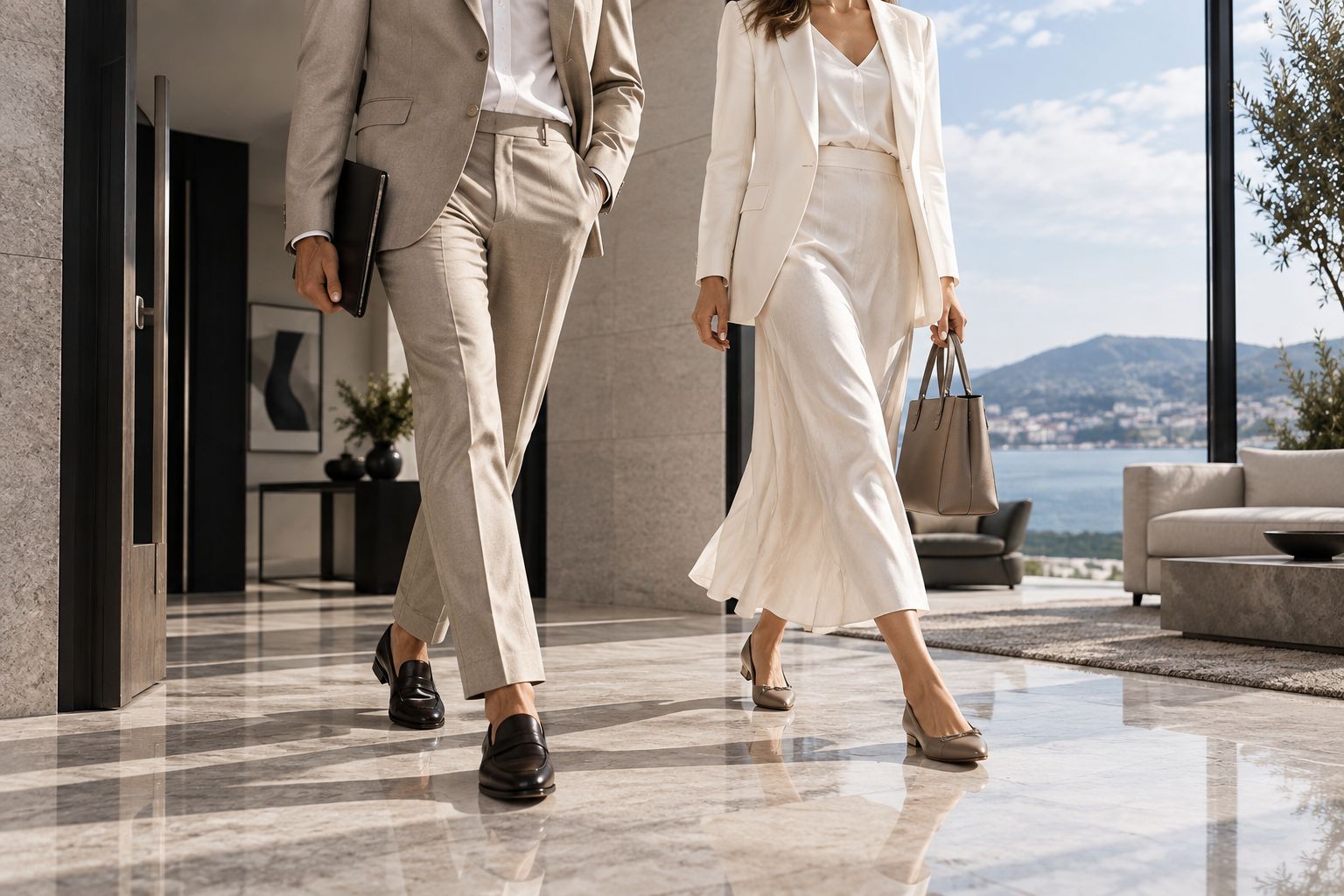
Before buying, photograph your existing shoes with 2 complete work outfits: your most formal appointment look and your everyday showing outfit. Look at the whole line from shoulder to floor. The shoe should support that line, not appear borrowed from a different wardrobe.
Slim trousers and an extremely bulky shoe create a deliberate contrast; use it only if that is the effect you want. A wider trouser hem needs enough shoe presence to avoid swallowing the foot. With skirts and dresses, assess the shoe's visual weight alongside the hemline rather than judging the shoe alone.
Once you know the missing role, Dellamoda is a place to explore Italian and European designer footwear. Choose by the individual item's documented details, not by assuming every shoe from a designer shares the same construction, fit, or country of manufacture.
- Pair streamlined shoes with clean, closely tailored silhouettes.
- Check wider trousers for a hem that catches or drags around the shoe.
- Assess pumps and flats with the actual skirt or dress length you wear.
- Keep one dominant detail: pronounced footwear texture or strong clothing pattern.
Match the sole to the surface, not the photograph
An attractive upper does not tell you how the underside behaves. Inspect the sole, read the item's stated construction details, and consider the surfaces on your route. Do not infer grip, cushioning, waterproofing, or suitability for long walks from a designer name.
A flat-looking sole is not a performance specification. Neither is a substantial boot profile. For an appointment that includes wet paving, gravel, or unfinished ground, choose footwear with documented suitability for those conditions or change the route and footwear plan.
Driving introduces another check: your shoes should let you operate the pedals without interference. Avoid deciding this from appearance alone. If your presentation pair is awkward for the drive, change before the appointment rather than compromising either task.
- Inspect the outsole rather than relying only on upper photographs.
- Look for explicit grip or weather-performance information when you need it.
- Keep dress footwear away from work areas requiring protective equipment.
- Check that your chosen driving shoes allow unobstructed pedal movement.
- Carry a separate pair when outdoor access and indoor presentation conflict.
Build a small rotation with distinct roles
For your 2026 wardrobe, consider 3 footwear roles before adding more pairs: a tailored appointment shoe, a showing-day shoe that fits comfortably, and a conditions-specific option. These are roles, not an instruction to buy three new pairs. Your existing shoes can fill them.
The appointment shoe should work with your strongest client-facing outfit. The showing-day shoe should support natural movement without looking disconnected from your clothes. The conditions-specific option answers a genuine need, such as a site instruction or documented weather protection, rather than a seasonal styling impulse.
A fourth pair earns its place only if it solves something the others do not. Another decorative loafer is a pleasure purchase; it is not a substitute for a missing walking or weather option. Be honest about which kind of purchase you are making.
- Assign an existing pair to each role before shopping.
- Prioritize the role your current wardrobe cannot cover.
- Choose versatile colors based on the clothes you actually wear.
- Keep a clean spare pair accessible when your itinerary changes.
Maintain the finish without improvising care
Presentable shoes need attention to the details visible at conversational distance: clean edges, tidy laces, and a finish appropriate to the material. Start with the maker's instructions. Smooth leather, suede, fabric, and exotic skins do not share one universal care routine.
Dellamoda's designer footwear selection includes styles that call for different ownership decisions. Read the individual material and care information before choosing a pair you intend to wear frequently. An expressive surface is appealing, but it needs to fit your willingness to maintain it.
For your 2026 work routine, inspect shoes when you put them away, not just when you are already late. That gives you time to address a loose lace, a marked upper, or a worn heel before the next appointment.
- Remove surface dirt using a method suited to the stated material.
- Follow material-specific guidance before applying creams or protective treatments.
- Check soles and heels for wear that needs professional attention.
- Let damp footwear dry according to the maker's instructions, away from direct heat.
- Keep spare laces and appropriate care supplies with your work wardrobe.
Compare the shoe types by appointment
No shoe type wins every real estate assignment. Use this table to choose the role first, then assess the individual pair's fit and documented construction. The advantages below are styling and adjustment characteristics, not promises of comfort or grip.
| Option | Best for | Useful advantage | Key limitation |
|---|---|---|---|
| Loafers | Tailored business-casual appointments | A clean transition between trousers and footwear | No laces to adjust the fit across the instep |
| Derby shoes | Tailored meetings where you want lacing adjustment | Open lacing allows adjustment across the instep | The dress-shoe shape does not establish walking comfort |
| Oxford shoes | Formal presentations and suit-led wardrobes | Closed lacing gives a restrained, dress-focused appearance | Less visually adaptable to relaxed casual outfits |
| Flats | Skirt, dress, and trouser wardrobes without a raised-heel emphasis | Easy to integrate into different outfit proportions | A low profile does not establish support or secure fit |
| Pumps | Dressier appointments with a controlled walking route | A defined heel changes the line of skirts and trousers | Heel height and shape need an individual stability check |
| Restrained sneakers | Showings where the established dress code is casual | They complement relaxed tailoring without requiring a dress-shoe silhouette | Not appropriate for every client's or firm's dress expectations |
| Ankle boots | Covered-foot styling with trousers or longer hems | They add visual structure to a seasonal outfit | Coverage does not prove weather protection or site safety |
For sneakers, restraint means a shape and finish that make sense with your jacket and trousers, not a universal rule against color. For dress shoes, personality can come through texture or an interesting silhouette. Choose expression deliberately; do not ask conspicuous shoes to do the work of good tailoring.
Common shoe mistakes real estate agents make
Dressing for the listing photographs instead of the showing
A striking shoe can look excellent beside an architectural staircase and still be wrong for repeatedly climbing it. Separate your photographed outfit from your working outfit when their requirements differ. Your 2026 wardrobe should accommodate both, rather than forcing one pair into every role.
Treating every property as a formal appointment
A suit and polished Oxford can be right for a presentation and wrong for unfinished access paths. Ask about the visit before choosing your clothes. If protective footwear is required, comply with that requirement; a luxury boot is not a stylistic workaround.
Assuming a familiar designer guarantees familiar fit
Different models can have different shapes and closures. Start the fit assessment again with each pair, even if you already own shoes from that label. Your established size is a starting point, not a verdict.
Planning to hide discomfort until the appointment ends
A long conversation is precisely when discomfort becomes difficult to ignore. Keep an alternative pair available and choose the comfortable option before meeting the client. There is no styling benefit in shoes that make you constantly shift your weight or watch the floor.
Forgetting the shoe-removal moment
Where a property asks visitors to remove shoes, the outfit includes socks or hosiery as well as footwear. Choose a pair you can remove without a prolonged struggle, and keep everything underneath presentable. Follow the property's instructions rather than assuming shoe covers or shoes indoors are acceptable.
FAQ
What are the best designer shoes for real estate agents in 2026?
The best designer shoes for real estate agents fit securely, suit the appointment's dress code, and match the surfaces on the route. Start with loafers or lace-ups for tailored outfits, then assess the individual pair rather than relying on its designer name.
Can real estate agents wear designer sneakers to showings?
Designer sneakers work for showings where the established dress code is casual. Choose a silhouette that complements your tailoring, and use dress footwear when the appointment calls for a more formal presentation.
Are loafers better than Oxford shoes for property tours?
Loafers are not automatically better than Oxford shoes for property tours. Loafers offer a slip-on design, while Oxfords offer lacing; the better choice is the pair that fits securely and suits your outfit and route.
Should women real estate agents wear heels or flats?
Women real estate agents should choose heels or flats according to fit, stability, and the appointment's walking demands. Flats are not automatically supportive, and pumps should be assessed in the actual outfit and on a suitable indoor fitting surface.
Do expensive designer shoes guarantee all-day comfort?
A designer label does not guarantee all-day comfort. Assess the individual shoe's fit, closure, sole, and stated construction, and reject a pair that causes persistent discomfort.
Can I wear designer boots to a construction-site showing?
Wear designer boots to a construction-site showing only if they meet the site's stated footwear requirements. A boot's appearance or ankle coverage does not establish protective performance.
What should I check before buying designer shoes from Dellamoda?
Check the individual product's documented materials, sizing information, construction details, and care guidance before choosing Dellamoda designer shoes. Do not infer weather protection, comfort, or country of manufacture from the brand name alone.
One last thing
Before your next appointment, look at your shoes from behind. The back of the heel, the trouser hem, and the heel counter are easy to overlook when dressing in front of a mirror. Clients following you through a property see that angle regularly. A tidy rear view is a more useful final check than another accessory.