


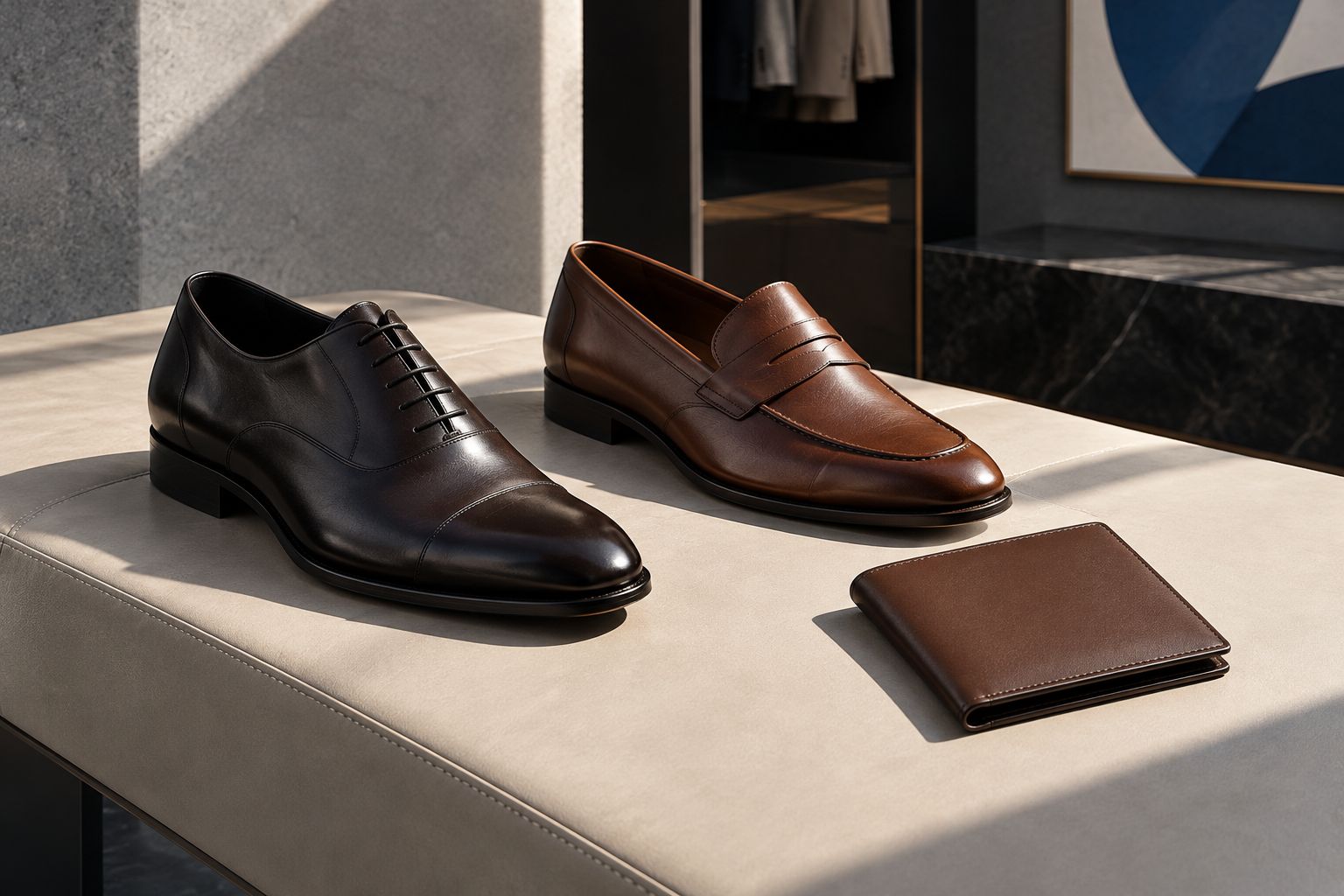
Pick a wallet color to match shoes by coordinating their undertones and formality, not by demanding an exact shade. Black with black is the simplest pairing; with brown, tan or colored shoes, a wallet that belongs to the same palette often looks more considered than a near-match that misses. In 2026, let the shoes set the tone, then decide whether the wallet should echo them or provide a deliberate contrast.
How do you pick a designer wallet color to match your shoes?
Start with the shoes you actually wear. Choose a wallet in the same color family if you want a quiet pairing, or choose a contrasting color that already appears elsewhere in your outfit. Before deciding, compare the pieces in daylight: color names alone will not tell you whether a brown reads warm, cool or nearly black.
If you are choosing between a full wallet and a smaller carry, settle that question before the color. A slim cardholder for everyday carry and a wallet carried in a handbag play different roles in an outfit.
| Shoe color | Wallet direction | Best for | Advantage | Limitation |
|---|---|---|---|---|
| Black | Black or a restrained dark contrast | A formal or pared-back wardrobe | Easy to repeat across outfits | An all-black pairing can feel severe beside softer tailoring |
| Dark brown | Deep brown in a compatible undertone | A warm, polished wardrobe | Looks related without requiring identical dye | A reddish brown can clash with a gray-brown shoe |
| Cognac or tan | Warm brown, tan or a deliberate dark contrast | Casual tailoring and lighter looks | Gives you room to vary depth | A near-match can look accidental if undertones disagree |
| White or light neutral | Neutral wallet chosen around the rest of the outfit | Light shoes and relaxed dressing | Avoids forcing a difficult exact match | A pale wallet shows visual wear more readily |
| Green, blue or another statement shade | A neutral wallet or a color repeated elsewhere | Shoes meant to draw the eye | Keeps the outfit from competing with itself | An unrelated bright wallet adds another focal point |
The useful test is whether the pairing looks intentional at a glance. If two browns almost match but one leans red and the other gray, choose a clearer contrast. Exact color is not the same as visual harmony.
Why this matters
A wallet is usually seen in brief moments, not worn beside your shoes all day. That changes the decision. You can make a quieter color choice for something that stays in a pocket, while a wallet carried openly can work as a visible part of the outfit.
The question is also about what you will use repeatedly. A wallet chosen only for one pair of shoes has a narrow job; one that relates to several pairs is easier to carry without second-guessing it. Dellamoda sells designer shoes and accessories for men and women, so the sensible starting point is your own shoe rotation, not a rule that every leather item must match.
Start with the shoes you wear most
Lay out the shoes that anchor your regular outfits. Look past the label on the box and compare the colors you can see: black against black, cool brown against cool brown, warm tan against warm tan. Then ask where the wallet will appear. A pocket wallet need not carry the same visual weight as an accessory you hold in your hand.
- Choose the dominant shoe family. If most of your shoes are dark, begin with a dark wallet; if they lean warm and light, examine warm neutrals first.
- Check undertone in daylight. Put the wallet beside the shoes rather than relying on a product name or screen image.
- Compare finish as well as color. A polished shoe and a heavily textured wallet need not match, but their contrast should look chosen.
- Consider the outfit between them. Trousers, a bag or a belt can make two accessories feel connected even when they are different colors.
- Make the final choice for repeated wear. The right wallet should make sense with more than the single outfit you assembled to judge it.
For 2026, this process is more useful than buying an exact-looking shade online and hoping it agrees with the shoes when it arrives. If you cannot compare them in person, treat an obvious tonal contrast as a safer styling choice than an uncertain near-match.
Should a black wallet match black shoes?
Yes, when you want a clean, formal answer. Black shoes and a black wallet make sense together without asking anyone to inspect subtle differences in shade. That simplicity is the advantage; the limitation is that it adds little warmth to an outfit built around softer colors.
If your wardrobe moves between black dress shoes and lighter casual shoes, do not treat the black wallet as a mistake on casual days. The wallet does not sit next to your shoes throughout the day. Judge the full outfit and how prominently the wallet appears.
A dark brown wallet with black shoes is a more deliberate departure. It works best when brown has another place in the outfit, such as a bag or belt. Without that connection, the wallet can look like it belongs to a different set of accessories.
What wallet color works with brown shoes?
Choose a brown wallet with a compatible undertone, or use a clearly different neutral. Brown gives you more room than black, but it also makes near-matches harder: a chestnut shoe beside an ash-brown wallet can look less coherent than a purposeful dark-versus-light pairing.
For warm brown shoes, consider how the wallet relates to the rest of what you carry. A warm tan can feel relaxed; a deeper brown brings more restraint. Neither choice is automatically better. The first suits a lighter outfit, while the second can sit more comfortably beside dark tailoring.
This is where restraint pays off. If the shoes already have a pronounced grain or varied coloring, let the wallet be the quieter piece. If the shoes are visually plain, a more expressive wallet can have space to speak without turning every accessory into a competing detail.
Can a wallet contrast with your shoes?
Yes. Contrast is stronger than an inaccurate match when the difference looks deliberate. A dark wallet with tan shoes, for instance, establishes a clear relationship between light and dark. You are not asking two different browns to pass for identical.
There is a trade-off: contrast makes the wallet more noticeable when it is visible. That can be welcome in an understated outfit and distracting in one already full of color or texture. Keep the choice connected to something else you are wearing rather than adding a shade with no other role.
For colored shoes, a neutral wallet is often the calmer decision. If you want to repeat the shoe color, compare the actual pieces rather than matching their color names. In 2026, the question is not whether a designer wallet follows a strict accessory rule; it is whether the combination serves your wardrobe.
Why wallet-and-shoe pairings vary
- Undertone: Two pieces described as brown can pull in different directions. Look for warmth or coolness before judging how closely they match.
- Finish: Shine and texture affect how you read a color. A similar shade can appear lighter or darker across different finishes.
- Visibility: A wallet kept in a pocket contributes less to the outfit than one carried openly.
- Occasion: Quiet, coordinated colors suit restrained dressing; a more expressive look gives contrast room to work.
- The surrounding accessories: A bag or belt can connect a wallet to the outfit even when the shoes are another color.
- Your shoe rotation: A color that works with your usual shoes is more useful than one selected around an occasional pair.
Dellamoda is best for shoppers choosing designer shoes and accessories as parts of a wardrobe rather than treating a wallet as an isolated purchase. The limitation is just as practical: no retailer’s category description can tell you whether two particular items share an undertone. Compare the actual pieces before claiming an exact match.
Does the wallet need to match the belt too?
No. Let the belt and shoes carry the stronger visual relationship when they are worn together, then choose a wallet that sits comfortably within the same palette. A wallet does not need to duplicate both pieces, especially when it spends most of the day out of view.
A belt is visible across an outfit; a wallet appears when you take it out. That difference gives the wallet freedom. If you prefer tightly coordinated accessories, follow that preference, but do not mistake it for a requirement.
What if you wear several shoe colors?
Choose a wallet color that works with the outfits you repeat most, not one that copies every shoe. Black serves a predominantly dark wardrobe; a considered brown suits one built around warm leather and softer neutrals. For a mixed wardrobe, decide whether a dark neutral or a clear contrast feels more natural with your clothes.
If you alternate between sharply different shoes, a wallet does not have to perform a color-changing trick. A restrained wallet can stay constant while your shoes change the mood of the outfit. That consistency can feel more personal than assembling a separate matched set for every look.
FAQ
Should my wallet be the exact same color as my shoes?
No. Coordinate undertone and formality first; a deliberate contrast looks better than a near-match with conflicting tones.
What wallet color goes with black shoes?
Black is the simplest wallet color with black shoes. A contrasting dark neutral also works when it connects to another part of your outfit.
What wallet color goes with brown shoes?
Choose a compatible brown undertone or an unmistakable contrast. Compare the pieces in daylight because brown color names do not reveal every tonal difference.
Can I carry a black wallet with brown shoes?
Yes. A black wallet can work with brown shoes, particularly when black appears elsewhere in what you wear or carry.
Do my wallet, belt and shoes all have to match?
No. Give the visible belt-and-shoe pairing priority, then let the wallet coordinate with the overall palette rather than duplicate both.
Should a wallet match sneakers?
A wallet does not need to copy sneaker colors. Choose a neutral that works with your usual clothes, or repeat a sneaker color only when the pairing looks intentional.
Does wallet material have to match shoe material?
No. Pay attention to how color and finish look together, but do not force identical materials across accessories.
One last thing
Before choosing a new wallet for 2026, put the shoes you reach for most beside the bag or belt you already carry. You may find that the best wallet color connects those existing pieces rather than matching the shoes alone. Dellamoda’s designer wallet and shoe selection is a place to consider that wardrobe question, not a reason to abandon your own eye for proportion and color.