


Designer accessories for architects are the handful of well-made pieces (shoes, belt, eyewear, wallet, tie) that express a point of view about line, proportion and material without competing with the drawings on the table. The brief differs from a banker's or a lawyer's: your wardrobe is read by clients who judge your eye before they see your portfolio.
Why designer accessories matter for architects
Your day moves between a client meeting, a site walk and a late session at the desk. Accessories are the only part of the outfit that travels across all three unchanged, so they do the heavy lifting.
An architect's audience is also unusually trained to notice. People who commission buildings tend to notice proportion, seams, edge finishing and the way a material ages. A belt with clean edges or a frame with a considered bridge reads as the same discipline you bring to a detail drawing.
The practical constraint is real, too. Site visits mean uneven ground, dust and weather; studio days mean hours seated. These pieces need to look sharp while tolerating uneven ground, dust, weather and long studio hours. Eyewear matters especially for long screen hours, and our guide to designer eyeglasses for a professional look covers frame choice in more depth.
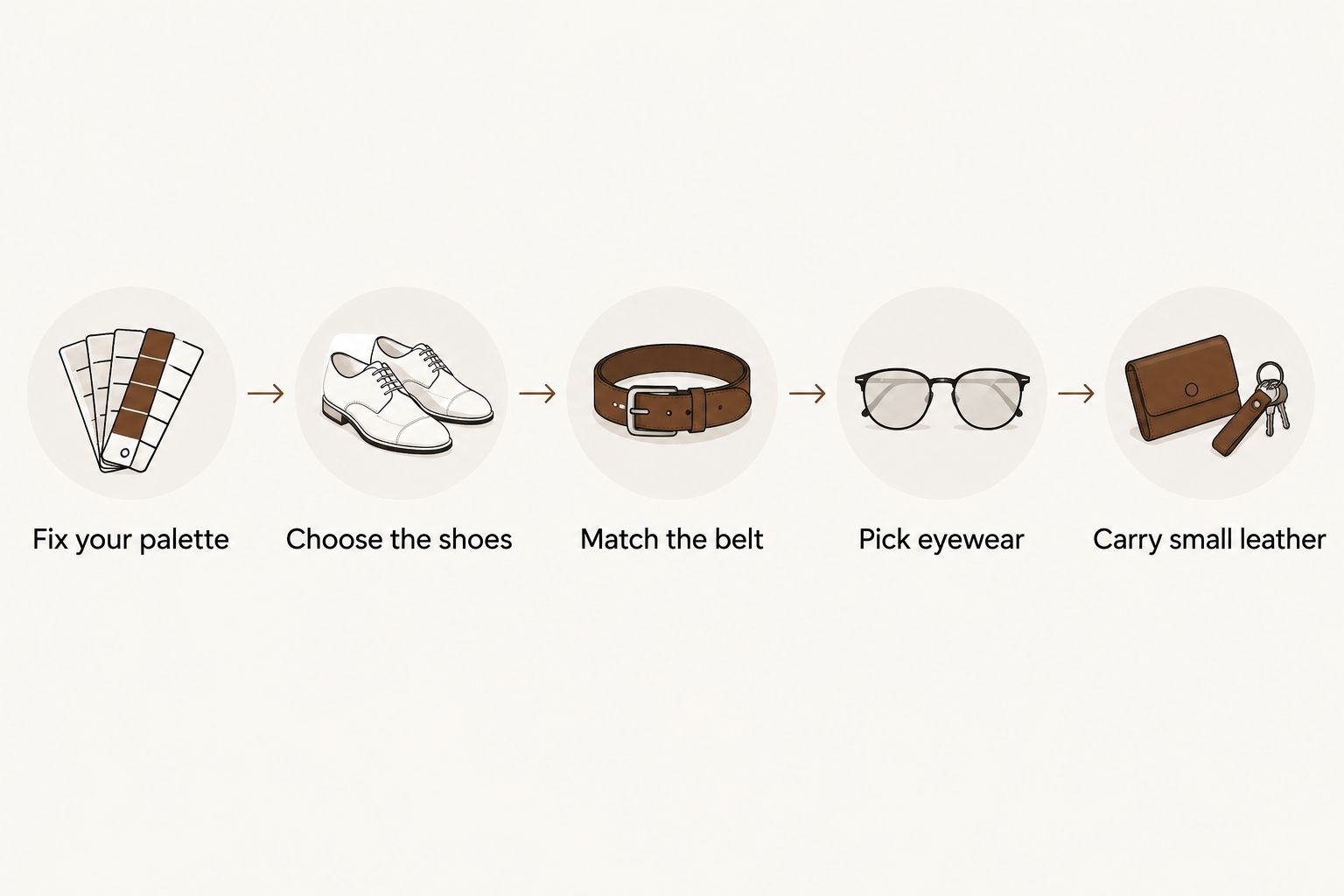
How to build your accessory kit
Start by auditing what you already own against a clear palette, then fill genuine gaps one piece at a time.
Fix your palette before you buy anything
Architects tend to dress in a controlled range, and that discipline is an asset. Decide your base colors first, then choose accessories that sit inside it.
- Pick two or three neutrals: black, charcoal, navy, stone, or a single warm brown.
- Choose one accent family, such as cognac leather or a deep green, and repeat it once or twice, not everywhere.
- Photograph your current outfits on a plain wall and see which pieces fight the palette.
- Keep metal finishes consistent: one tone across belt buckle, frame hinges and watch.
- Retire anything you reach for out of habit but never feel good in.
Choose shoes that handle site and studio
Shoes are the piece clients see first and the one you feel by mid-afternoon. A smooth calf oxford or a clean, low-profile leather sneaker covers most days; a boot suits colder site visits.
- For meetings, a plain-toe or whole-cut oxford in black or dark brown keeps the silhouette sharp.
- For site days, choose leather that tolerates scuffs and can be polished back, and avoid delicate finishes you will worry about.
- A minimalist leather sneaker bridges studio and client lunch when the dress code is relaxed.
- Check the sole profile: a slim, balanced line looks more architectural than a bulky one.
- Rotate two pairs so leather rests between wears.
If you want a refined lace-up with a clean profile, the Cesare Paciotti 308 lace-up oxfords in white calf leather are a lighter, more graphic option for women's wardrobes. White calf leather needs more care than a dark pair and is less practical for dusty site visits.
Match the belt to the shoe, then stop
The belt is a small piece that does a lot of quiet work. Keep it to the same leather family as your shoes and let the buckle stay understated.
- Match color and finish first: matte with matte, polished with polished.
- Choose a buckle with a simple geometry; decoration reads as noise next to a clean shirt.
- Pick a width that suits your trousers rather than the trend.
- Own one black and one brown belt before considering anything exotic.
- Condition leather a few times a year so edges stay crisp.
The rules are laid out in detail in how to match a leather belt to your dress shoes.
Pick eyewear like a structural element
Frames sit in the middle of your face, which makes them the closest thing in your wardrobe to a facade. Treat them with the same logic you would a building: proportion first, ornament last.
- Match frame width to the width of your face, so the frame neither overhangs nor pinches.
- Thin metal or fine acetate suits a precise, drawing-board look; heavier acetate reads more editorial.
- Choose a color from your palette, not a new one.
- For sunlit site visits, decide on lens color and polarization before the frame style.
- Keep a hard case in your bag; frames in a pocket collect scratches.
The Dellamoda collection includes designer eyewear and sunglasses from European houses. Browse the Dellamoda homepage to see current frames and shop by category.
Carry small leather goods that stay slim
A wallet or card holder is handled in every meeting, at every coffee and every site-office check-in. Slimness and finish matter more than logo.
- Carry fewer cards; a slim holder keeps the line of a jacket or trouser pocket clean.
- Choose leather in the same family as your belt and shoes.
- Check the edge finishing and stitching before the brand name.
- A compact wallet in a warm brown works against dark neutrals without shouting.
- Empty it every month; bulk is the quickest way to ruin a good piece.


Add a tie only when the room asks for one
Most architects wear a tie rarely, which is why the ones you own should be good. Choose for texture and a quiet tone; a tie with a bold graphic competes with your own presentation boards.
- Silver, grey and muted tones sit comfortably with charcoal and navy.
- Silk gives a clean knot and a slight sheen that reads well in a presentation room.
- Match the tie width to your lapel width.
- Let the shirt stay plain and let the tie carry the single point of interest.
- Store ties hung or loosely rolled so the silk keeps its shape.
Comparing your options
| Piece | Best for | Key limitation |
|---|---|---|
| Leather oxfords | Client meetings and design reviews | Less forgiving on rough site ground |
| Minimal leather sneakers | Studio days and relaxed client lunches | Too casual for formal presentations |
| Leather belt | Anchoring the palette, daily wear | Needs to match shoe finish to work |
| Designer eyeglasses | Long screen hours and everyday identity | Needs the right size and fit for your face |
| Designer sunglasses | Site visits and travel | Not suited to indoor meetings |
| Slim wallet or card holder | Daily carry without pocket bulk | Holds fewer cards and cash |
| Silk tie | Formal reviews and award evenings | Rarely worn, so quality over quantity |
Common mistakes architects make with accessories
- Letting every piece speak. One statement element per outfit is plenty. A loud belt, loud frames and a patterned tie turn the outfit into a collage.
- Ignoring leather matching. A brown belt with black shoes is the most common slip in an otherwise precise outfit.
- Buying shoes that only suit the office. If your calendar includes site visits, choose leather you can polish and resole, not a pair you are afraid to scuff.
- Overstuffing the wallet. A bulging wallet distorts the line of a trouser pocket and undermines the sharp silhouette you worked on.
- Neglecting care. Premium leather and acetate frames reward basic upkeep. Our guide on how to store designer sunglasses and eyeglasses is a quick start.
Where Dellamoda fits
Dellamoda is an online luxury retailer selling designer Italian and European shoes, boots, sneakers, handbags, wallets, belts, eyewear and other accessories. For architects, the useful angle is range: you can assemble shoes, belt, eyewear and small leather goods in a single, consistent palette rather than assembling a kit from several stores.
Exotic and statement leathers are bolder than most architect wardrobes need. Start with smooth calf and quiet finishes, then add one distinctive piece only if it suits your work and wardrobe.
FAQ
What are the best designer accessories for architects?
Start with shoes, a belt, eyewear and a slim wallet in one coordinated palette. These four pieces are visible in nearly every client interaction, so they carry the most weight.
Should architects wear ties?
Only when the room calls for it, such as a formal review or an awards evening. Choose a quiet silk tie in a tone that sits within your palette.
What shoes work for both studio and site visits?
Dark smooth leather in an oxford or a clean leather sneaker works for both. Choose leather you can polish and avoid delicate finishes.
How do I choose designer eyeglasses as an architect?
Choose frame width to match your face, then pick a color from your existing palette. Fine metal or slim acetate suits a precise, restrained look.
Should my belt match my shoes?
Yes. Match the color and finish, matte with matte and polished with polished, so the outfit reads as one deliberate decision.
Do I need exotic leather to look designer?
No. Smooth calf and quiet finishes suit most architect wardrobes. Exotic leathers are a statement choice to add sparingly.
How many accessories should I wear at once?
Keep one point of interest per outfit. If your frames are bold, let the belt and wallet stay plain.
How do I keep leather accessories looking good over time?
Rotate shoes, condition leather a few times a year and store eyewear in a hard case. Basic care extends the life of well-made pieces.
Practical takeaway
Before you add anything new, lay out your current shoes, belt and wallet together in natural light. If two of them clash, replace the oldest first. Fixing a mismatch improves your outfit more than any new statement piece.