


Yes, designer sunglasses can have prescription lenses, and most full-rim acetate frames from the major Italian houses are good candidates. The catch is the frame, not the brand: steep wraparound curves, very small lens openings and some rimless or metal constructions limit what an optician can cut and fit in 2026.
- Designer sunglasses prescription lenses are possible: an optician fits Rx lenses into most full-rim acetate frames.
- Frame shape matters more than brand. Steep wraparounds and tiny lens openings are the usual failures.
- Higher prescriptions and progressives need larger, flatter frames and an optician's measurements.
- Ask for UV400 protection and decide on polarization before the lenses are cut.
Why this matters
A designer frame is a considered purchase. Swapping its factory lenses for prescription ones changes the tint, the thickness at the edges and sometimes the balance of the frame on your face. Decide before you buy, not after the optician says no.
Dellamoda carries designer sunglasses from houses such as Gucci, Alexander McQueen and Bottega Veneta. The frame questions below apply to any of them, and the product page for each pair is where you confirm its measurements before taking it to an optician.
Can designer sunglasses have prescription lenses?
Yes. The process is the same whether the frame is designer or not: an optician removes the demo lenses, measures your pupillary distance and lens height, and cuts new lenses to your prescription in the tint you choose. The frame has to physically accept them.
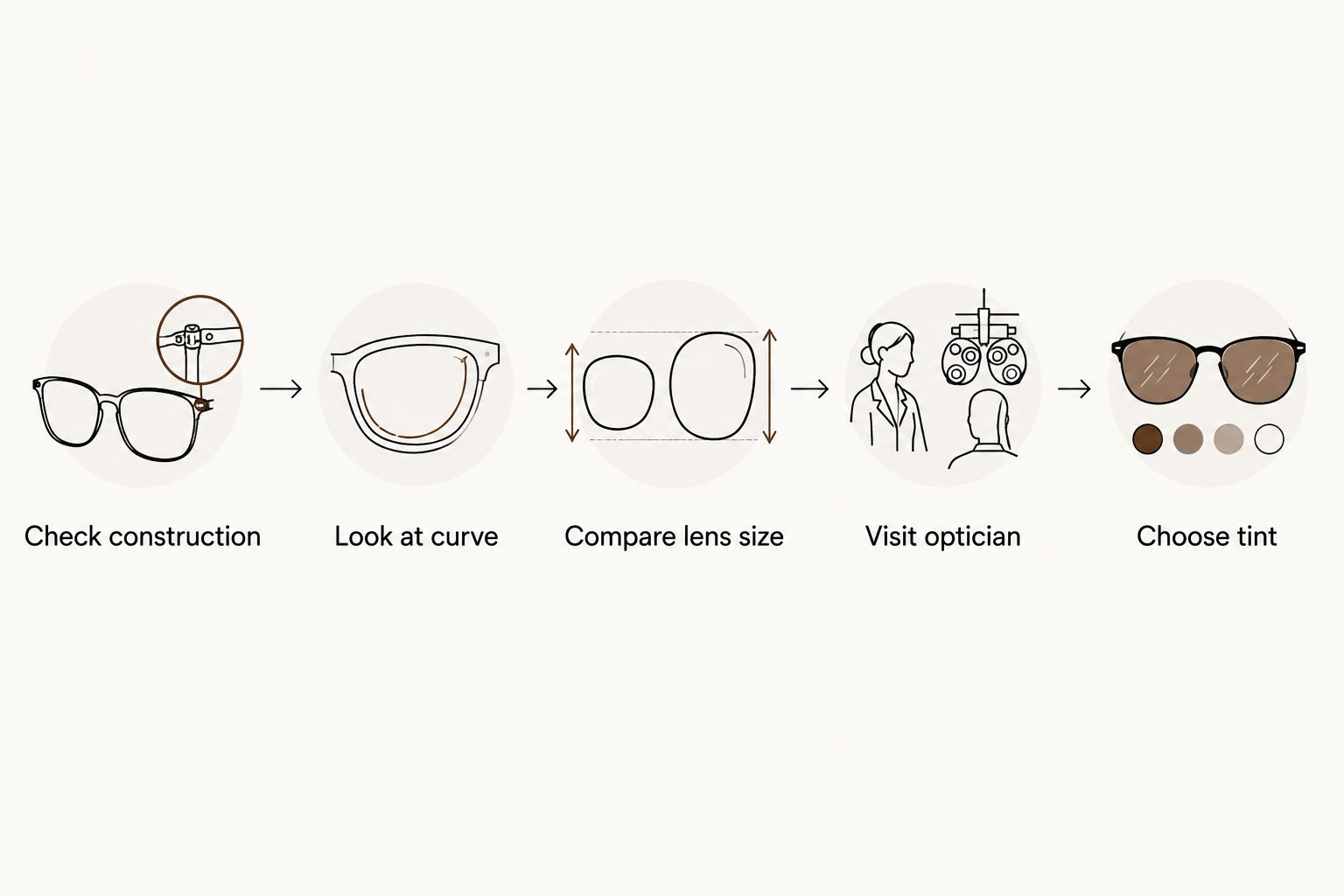
Work through this order:
- Check the frame construction. Full-rim acetate is the easiest to glaze. Semi-rimless and rimless designs can work but depend on the mounting.
- Look at the curve. A flat to gentle curve takes prescription lenses cleanly. A deep wrap bends the lens enough to distort vision, especially with astigmatism.
- Compare lens size to your prescription. A stronger prescription makes thicker edges, which need a lens opening large enough to hide them.
- Take the frame to a qualified optician with your current prescription and have them confirm it is suitable before you commit to lenses.
- Choose tint, polarization and coatings with the optician, then order the lenses.
The process comes down to five checkpoints, each one a place where a frame can fail.
Which designer frames take prescription lenses best
No brand name guarantees a fit. Shape and build do. Here is how common styles behave.
Full-rim acetate: the safe choice
Thick acetate holds a lens firmly and hides edge thickness. Square, rectangular and cat-eye acetate frames, the shapes most designer houses build around, are the easiest to glaze. Gucci, Alexander McQueen and Bottega Veneta all make them.
Verdict: Buy, for most single-vision prescriptions.
Wraparound and shield styles: proceed carefully
A dramatic curve looks sharp and wears beautifully in sunlight. It is also where prescription lenses distort. Some opticians use free-form lenses to compensate, but results depend on your prescription and the optician's equipment.
Verdict: Hold until an optician has looked at the exact frame.
Rimless and metal-framed styles: check the mounting
Thin metal and rimless frames show the lens edge, so thickness is visible in a stronger prescription. Drilled mounts also put stress on a lens.
Verdict: Hold for higher prescriptions. Fine for mild ones with the right lens material.
Small or highly sculpted lens openings: skip for strong prescriptions
A narrow opening forces an off-centre fit, and thick edges show. A small frame is a style choice, but a strong prescription belongs in a larger one.
Verdict: Skip if your prescription is strong.
Why the answer varies from pair to pair
- Prescription strength. Mild prescriptions fit almost anywhere. Stronger ones restrict you to larger, flatter frames.
- Astigmatism. Cylinder correction is more sensitive to frame curve than plain near- or far-sightedness.
- Lens type. Single vision is the simplest. Progressives need enough vertical height in the lens for the reading zone.
- Frame curve. The deeper the wrap, the harder the optical job.
- Lens opening size. A larger opening gives the optician room to centre the lens and hide edge thickness.
- Lens material. High-index materials thin the edges for stronger prescriptions, which matters most in rimless and semi-rimless frames.
Do you want single vision or progressive lenses?
Single vision corrects one distance and suits most people who only need distance correction in the sun, which is the typical driving and walking use. Progressives blend distance and near correction and need a frame with enough lens height. If you are new to them, our guide to designer eyeglasses for first-time progressive lens wearers covers frame depth and adaptation.
Should prescription designer sunglasses be polarized?
If you drive, spend time near water or are bothered by glare off roads, polarization is worth asking about. It cuts reflected glare from flat surfaces. It can also make some digital screens harder to read, which matters for dashboards and phones. The reasoning is laid out in our guide to polarized sunglasses for glare-free driving.
Whatever you choose, ask for lenses that block UV up to 400 nm (often labelled UV400). A dark tint alone does not provide UV protection.
What tint should you pick?
Tint changes mood and function. Grey keeps colours neutral. Brown adds warmth and contrast. Gradient lenses are darker at the top and lighter at the bottom, which is handy for reading a phone or dashboard. Colour choice is its own decision, covered in the guide to choosing lens colour for designer sunglasses.
Frames worth taking to your optician
These Dellamoda frames are acetate builds in shapes that generally suit lens replacement. They are starting points, not a fit guarantee. Confirm any pair with your optician before you order.


Acetate is a forgiving material for glazing, and Havana patterns hide the edge of a thicker lens better than a solid pale colour does. That is a practical point in favour of tortoise-style frames if your prescription is on the stronger side.
Can I put prescription lenses in sunglasses I already own?
Often, yes. An optician can usually cut new lenses for a frame you already have, subject to the same checks on curve, size and construction. Bring the frame, not just a photo of it.
Will replacing the lenses affect the frame's appearance?
The frame stays the same. The lens shape, tint depth and edge thickness can change how the pair looks on your face. Ask the optician to show you the lens thickness estimate before you approve the order.
Is it better to buy prescription sunglasses or clip-ons?
Clip-ons suit people who wear one pair of eyeglasses daily and want sun protection occasionally. Dedicated prescription sunglasses give better optics and a cleaner look. If you wear sunglasses often, dedicated lenses are the better use of a designer frame.
FAQ
Can designer sunglasses have prescription lenses?
Yes. An optician can fit prescription lenses into most designer sunglasses frames, especially full-rim acetate. The frame's curve, size and construction decide whether a particular pair works.
Which designer sunglasses are best for prescription lenses?
Full-rim acetate frames with a flat to gentle curve and a generous lens opening work best. Gucci, Alexander McQueen and Bottega Veneta all make styles in that mould.
Can wraparound designer sunglasses take prescription lenses?
Sometimes, but steep curves can distort vision, especially with astigmatism. An optician needs to assess the exact frame before you order lenses.
Can I get progressive lenses in designer sunglasses?
Yes, if the frame has enough lens height for the reading zone. Taller lens openings suit progressives better than narrow ones.
Should prescription sunglasses be polarized?
Polarization is worth choosing if glare bothers you when driving or near water. It can make some digital screens harder to read, so weigh that against your daily use.
Do prescription sunglass lenses block UV?
They can, but you have to ask. Request lenses with UV400 protection, which blocks UV light up to 400 nm. Tint depth is not a substitute.
Can I put prescription lenses in sunglasses I already own?
Usually, yes. An optician checks the frame's construction, curve and lens size before cutting new lenses.
One last thing
If you are choosing between two frames you like equally, take both to the optician before you commit. The one with the larger, flatter lens opening will almost always give a better result with your prescription, and that is worth more in daily wear than a slightly better silhouette. For a wider look at the category in 2026, our guide to designer sunglasses for women covers shapes and fits.